Monday, January 6, 2014

Back-to-School Bliss

There is no calm like that which follows the end of a two-week school vacation. I actually had two out of three in school last Thursday, which didn't make much of a dent in the chaos since the one who was still home was the almost-three-year-old (she is, suddenly "almost three"--not sure how it happened but there was a shift and she's hardly two at all, anymore. She's on a M/W/F preschool schedule, which, in this new stage, does not feel like nearly enough).

And then, on Friday, it snowed a few inches in New York and de Blasio, the show-off, cancelled school. The snow day did have some plusses:

First, I went sledding with my children, for the first time. Ever. We used to live in the plains of downtown, where the biggest hills were the snowdrifts blocking the crosswalks around Union Square. We built some snow-people in our downtown days, padding around Stuyvesant Square in full-body snow gear. But sledding required planning, and a subway ride (!). But no more. We are now just blocks away from a Riverside park sledding hill so desirable that the local CBS news station was there filming when we arrived! (And this is why no one watches the local news). It was a brisk 14 degrees out when we got there, and sled we did, hopping up and down in between runs to keep the circulation going in the toes. It was a classic New York family moment. Newsworthy, even.

Second, Josh made soup.

That's it for the plusses. School is good for the kids, good for the parents. Especially those of us writers/ artists who need a room of our own (or at least a quiet table) to work. Sometimes it feels like school vacations are black holes on the calendar--projects in progress will be suspended until the children leave again. I mean, I'm not saying these black holes aren't enjoyable. It's nice to have a relaxed relationship with time and schedules, and to loll with family and friends. But when it comes to personal productivity, I can't even open a file without a kid reading over my shoulder. Without privacy and the promise of prolonged quiet, it's not even worth trying.

For those of you hunkering down with your kids beneath the talons of the Polar Vortex, all I can say is I feel for you. My parents love to tell stories of their Omaha days, where you couldn't open the door for all the feet snow, and the minus minus minus wind chills (and 100's+ in the summer!), and forget sledding--it really is the plains!--and all I can say is, all the power to you middle-of-Americans. Enjoy the football and let me know when they clear the ice off the runways so you can come visit us in our mild-weather paradise.

Here's to 2014, and many happy days of school ahead.

What we all want to do after two weeks of vacation.

Tuesday, December 17, 2013

The Santa Talk (Jewish Edition)

It's that jolly time of year! Maybe because Chanukah is already long over, this Christmas season has arrived in seemingly brighter shades of red and green than usual.

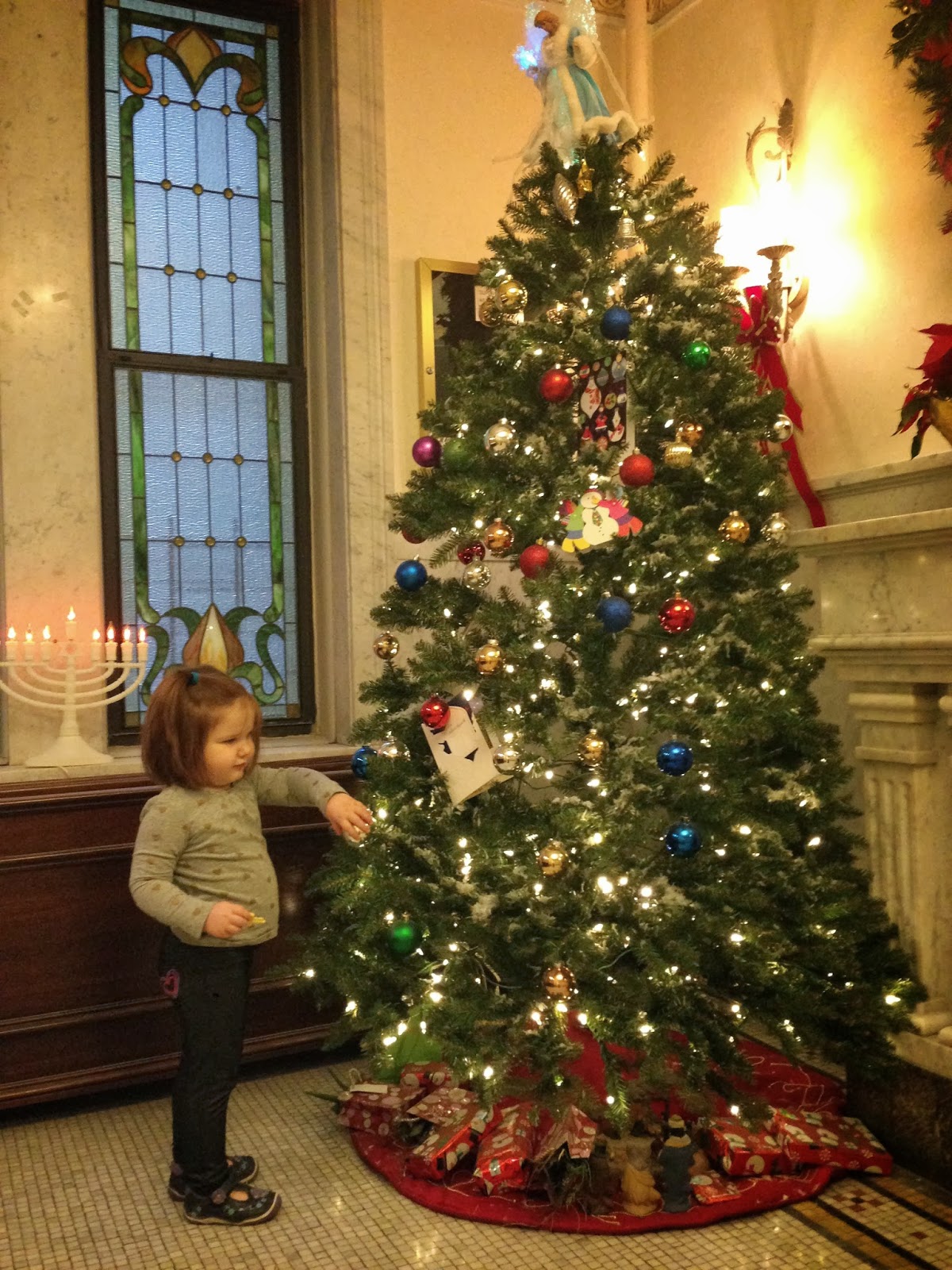
Or maybe it's just that my two-year-old is experiencing her first conscious Christmas. And she's blown away. For a week or two, we couldn't walk through the lobby of our building without Louisa stopping to admire the electric menorah. Then, one day, the TREE arrived. No matter that the tree itself is made of green plastic confetti (such a bummer--what's the point without the lovely smell?); it is towering, it is covered in shiny colored balls and lights, it has wrapped presents and a little baby Jesus snuggled underneath its embracing fronds. All in all, completely amazing to two-and-a-half-year-old eyes. It's difficult to pull her away.


When we finally step foot out of our building, within three blocks we encounter one of several Christmas tree vendors, camped out on the sidewalk 'til the big day, with their dozens of trees, bright lights, and blow-up Santas.

Let me back up. This child already has an abiding love for symbols of the dominant faith. She loves church bells. She knows which churches in our neighborhood have the ringing capability, and squeals on the occasions that the bells happen to sound when we are in hearing distance. "I hear the church bells!" she yells, which garners delighted smiles from passers-by, who probably imagine her as a future choirgirl.

Anyway, about the blow-up Santas. There's a giant one above the tree stand on the west side Broadway, and I've found myself distracting Louisa so she doesn't notice it. She'd have to look up to see it, so it's not that hard. All I have to do is strike up a conversation about what she did in school that day, or what we'll have for dinner, or whether we'll hear the church bells on the way home.

I just don't want to have the Santa talk with her just yet. You know, the Jewish version. The one where you tell your kids that different people believe different things and we have lots of nice beliefs but we don't believe in Santa. (And shhh, don't say anything to your friends about what I just told you about Santa. Bella made this mistake once and it still haunts her.)

Here's where I admit that I've been avoiding putting on one of the four episodes in the current TWC on-demand Dora rotation: "A Present For Santa".  Yes, that's right. I'm the Christmas censor. I figure Louisa can learn about Christmas on a need-to-know basis. This year: beautiful trees, lights, and empty fake presents that I constantly have to tell her to put back and stop shaking. Next year: red-cloaked bearded man brings presents to our neighbors, but not you.


(But, don't worry, we have Chanukah!!)

Tuesday, December 10, 2013

On the Loss of Things, and True Need

We've had a bad run of luck with things, lately.

Already, on this blog, I recounted the destruction last year of a laptop. (Dropped to the ground by adorable Loulou. So cute!) Then, last month, Ruby left her backpack on a city bus. Thankfully, we got that back, it's belongings all in place (including her brand new Kindle, which she had received for her birthday). Those 100th Street bus depot guys rock.

Earlier this fall, Josh bought a new bike for commuting to work, a fixie with orange wheels that he quite fancied, and within weeks it was snatched, from outside the Y where he was picking up Bella. Gone.

Then, on the first day of our recent family trip to Costa Rica, two of our backpacks were stolen. One of the backpacks held pull-ups, a portable potty, and a few changes of toddler clothes (the backpack itself was the one Ruby left on the crosstown bus--fated to leave us?), and the other held quite a few of the family's electronic gadgets, including the replacement laptop for the one that broke last year.

This last loss felt painful. I had been planning to do some writing while we were away--I had a freelance gig due on our return--and my means for doing so were gone. Our books and the e-readers they were stored on--gone. Our kids' entertainment for the return trip--also gone. Our camera to document the trip--ditto. Things that we had cared for, and cared about, and 'needed' were taken blithely, and there was nary a thing we could do about it. Enough things that we do not have the budget to replace them all, and will probably only replace a few.

In the day or two after, I felt waves of anger (It was just so unfair!) and sadness (But I'll never see these things again?) and guilt (We shouldn't have brought all that stuff with us. We should have been more careful.).  But more often I felt resignation and peace. I found myself saying, out loud: "Our kids are fine. We are fine. That's what matters."

Maybe we have to experience this kind of loss to appreciate what we have. I say that having spent some time in the past two days reading about the details of Dasani's life in poverty. The New York Times' profile of a homeless 11-year-old girl and her family living with so little, is wrenching in its details of what it means to be in need.

As I mentioned in a previous post, before Thanksgiving, we attended the kick-off for the West Side Campaign Against Hunger's Thousand Turkey Challenge, an annual fundraising (and turkey-raising) event to provide holiday food for the tables of poor New Yorkers. Bella and Ruby attended a discussion group for kids, in which they learned about the hunger and poverty cycles. There were a lot of kids in the room, which was refreshing to see. These kids need to know what it's like for the kids who weren't there on the fundraising night--the ones who come with their families during open hours for the food pantry, and "shop" for the food that sustains them. Food that is necessary, in a way that an e-reader or a camera will never be.

The turkey challenge was a fantastic success, which is good news for WSCAH and the families they serve. But the fact that the need is greater than ever, and that New York City's poor keeps growing, as the cost of living in this city rises and rises, is downright depressing.

Dasani imagines a video game called "Live or Die" in which winning means getting a house, and losing means returning to the shelter, "'which is death'". There are levels of need; Dasani's most basic needs--those of shelter and food--are barely being met.

If you want to talk about unfair, talk to her.


Friday, November 22, 2013

Thanksgivukkah Meshugana

Something about preparing to go away next week, as we've never done before (we usually stay local for the turkey holiday--so local that we walk to Thanksgiving dinner), has made my life cray-cray. Maybe it's the Thanksgivukkah (a word that I can neither spell, nor pronouce) thing that has sent me just this side of over-the-edge this week.

I'm not the only one. I've heard reports that one family member, a preschool teacher at a Jewish school, has been slightly manic trying to cover what should have been two separate months of curriculum over Hannukah and Thanksgiving: two staples of the Jewish preschool calendar. No doubt. Louisa came home today with a the classic hardware-nuts Hannukiah AND a "hand turkey". All in one day. It's enough to make your head spin.

I'm sure the unlikely confluence of these two first-semester holidays is what made our family decide to finally take the plunge and get on a plane to celebrate the most American of holidays in a foreign country (Costa Rica). I've celebrated Thanksgiving in England (something full-circle about that), but never in the tropics. I'm looking forward to eating local sweet potatoes (or some similar tuber) in a land at least closer to whence they actually hail (Did you know that there were no sweet potatoes--or any kind of potatoes, for that matter--in the Plymouth colony?--a little tidbit I picked up this week while researching a freelance story. Because domesticated potatoes come from South America, and they hadn't made it that far north yet, apparently...). Rum drinks and Thanksgiving sound appropriate, too. After all...rum, the triangle trade...it all brings back colonial history.

Bella is studying colonial history in school. There's a lot of talk, these days, even in elementary school, about the difference between history and myths. My girls are all over the "truth" about the first Thanksgiving. They ate oysters and clams! And venison! There was not a pumpkin pie to be found. Ultimately, the Thanksgiving story is about the triumph of needy humans over the scourge of starvation. The new Americans figured out, one way or another, how to eat and survive in their new, wild home.

Thanksgiving, like Hannukah, is so much about food. We eat the same things, year after year, such that we forget the origins of the ritual. I'm sure I thought, as a child, that kosher marshmallows were consumed by Native Americans and Pilgrims at their unified feast in 1621. In our family, we usually host a big Hannukah party. It has become our tradition to serve latkes and lox and (non-Beluga) caviar. Yum. Ask my girls and I would venture to guess they believe caviar is a Hannukah food.

Somehow, in the midst of this busy week of packing and finishing time-sensitive projects and cursing myself for not ordering sun-protective gear on the internet, since it is nowhere to be found in stores, we found time, as a family, to go visit a wonderful local organization with a mission to make sure every family in NYC can have a festive holiday meal. The West Side Campaign Against Hunger feeds thousands of families throughout the year. On Thanksgiving, the needy can receive a turkey, and all the accoutrements. For several years an interfaith coalition of synagogues and churches and schools have come together to raise money to support this mission. This year, both our synagogue and our school are members of the coalition.

On Tuesday evening, we attended the kick-off event for the Thousand Turkey Challenge. Bella and Ruby learned about the hunger cycle, and about food insecurity right here in NYC. I hope that they will appreciate our own feast even more, knowing that many families are guaranteed no such thing. Tzedakah and celebration go hand in hand, and what better way to celebrate Hannukah on Thanksgiving, than to donate some gelt to a worthy organization dedicated to feeding the hungry. Please consider donating a turkey, by clicking here.

Happy Thanksgivukkah!


Wednesday, November 13, 2013

Experience, But Not Expertise

As we both struggled to get our little ones bundled and out the door at the end of preschool this morning, I commiserated with another mother. All the other kids has already gone, but our two were sitting in their cubbies, ignoring our pleas.

"Louisa's been expressing her non-compliance lately," I said. Which is true. For example, earlier this morning, she insisted that she wanted to ride her bee to school. Here's a visual:
Needless to say, it's not our chosen mode of transportation, except between her bedroom and the living room. I had to literally pry her off the thing, screaming, so that I could then wrestle her into her puffy jacket, to get her out the door. Life is so unfair.

So, anyway, the mom of Louisa's co-conspirator in non-compliance says to me: "but at least you know what to do. I mean, you are experienced."

Ah, yes. That. The assumption that because she's not my first (or second) toddler, that I somehow know how to mind-meld my two-and-a-half-year-old into doing what I say. Ha.

So here's a story to prove that experience does not always equal expertise.

Louisa wore undies to school today for the first time. Hurrah! She's been using the potty since the summer at home, to varying degrees of success. But until now, I didn't have the confidence to send her to school in a pull-up. I was worried she'd pee all over the place. In fact, just last week she peed in the stroller while I was collecting the big girls from school.

This is only interesting because I did a better job toilet training my two older kids. They were both trained within a few days. We took away the diapers, they graduated to big girl underpants (except at night), praised them for their successes, and we never looked back. Done. I knew how to toilet train so well that I'd practically given seminars on the subject, to eager, newer parents who wanted to know how it's done.

And then, along comes child number three, and I do everything wrong. I started too early, because she had a bad rash and, let's face it, I was just so sick of diapers. Then, since she didn't really seem ready, I kept the potty around as an option, instead of an obligation. I put her in pull-ups whenever there was a chance of a possible accident, rather than just letting her get the hang of holding it in, and discovering the consequences. I even (shame) yelled at her, once, for peeing on the rug. And once for peeing on my bed. Major no-no. The potty training stressed me out this time, which for sure was the root of my trouble.

How could I have made all these mistakes, knowing what I know? No answer there, except that each kid is different, I suppose, and so is the parent, by the time the next developmental milestone arises. I keep thinking about that next approaching milestone for Louisa, which, unlike potty training, was actually very stressful the first time(s) we went through it with our older kids: the move from the crib to the bed. Once they can get out of bed, all bets are off. Parents lose.

So I've been wondering, is there any way we can maybe we can just skip straight from sleeping in the crib to sleep-away camp? Advice accepted. After all, you're all experts.


Friday, November 8, 2013

Bat Mitzvah Debate Follow-Up

Drumroll . . . we made the decision regarding when we should celebrate Bella's bat mitzvah.

It was fascinating discussing this question with so many deeply engaged, thinking people: rabbis, educators, and parents. Some rabbis prefer bat mitzvah at 13 because it keeps girls in Hebrew school another year. Several people I consider "professional" Conservative Jews told me they had never really pondered the question. One clergy member told me that in her congregation, bat mitzvahs are usually at 13, although 12-year-old girls are counted in the minyan. "We are consistently inconsistent!" she said.

The contemporary feminist arguments for bat mitzvah at 13 are strong. As my rabbi, Rabbi Jeremy Kalmanofsky, added to a Facebook discussion:
"one has to ask why rabbinic tradition assigned girls maturity to 12. I think it is not a modern assessment of intellectual or emotional maturity - though these may be real - but a less nuanced report about menarche. In other words: It was time to get busy! I would prefer that such considerations vanish from contemporary ritual decisions."
On the other hand, Professor of Rabbinics Rabbi Gail Labovitz said this, also on Facebook:
"I lean towards 12, though I get that it does not seem egalitarian, and I am very much, generally, committed to egalitarianism. The age [of bar/ bat mitzvah] does indeed have a link to the onset of puberty, but this is true for both boys and girls - indeed, well into the rabbinic period one can find contesting voices in rabbinic lit. as to whether bar and bat mitzvah should be decided by a universal age limit, or by demonstrating actual physical signs of puberty. At the same time, the rabbis did imagine that a girl "became" bat mitzvah at 12 just like a boy becomes "bar mitzvah" at 13 . . . . So in our day, if we are expanding the realm of mitzvot that we think women should be responsible for . . . . then those responsibilities kick in at 12 - and girls who don't fulfill them until a year later might be thought of as sinning..."

Compellingly, several people told me that bat mitzvah at 12 is a feminist ritual, because it celebrates girls' coming of age in a different way to how boys' maturity is celebrated; it breaks the pattern of using the masculine as the standard.

Then there are the practical issues. One rabbi/parent told me that her daughter was unhappy with her Hebrew school class, so holding her bat mitzvah at 12 was a way to "graduate" and move on to Prozdor (Hebrew school for high schoolers, in NYC). She was not the only rabbi who told me that they based their decision of when to hold their own daughters' bat mitzvah ceremonies primarily on the particular circumstances and needs of that child.

Bella goes to a Conservative day school where the practice is for girls to celebrate an in-school bat mitzvah at 12. Bella is eager to get the party started, so to speak, and wants to do what her friends will do. The bat mitzvah is a celebration of a change in status for the child, and as such, it makes sense to have the in-school bat mitzvah at the same time as the synagogue celebration.

In addition, I'm all for celebrating milestones at once. In general, I try to make the kids' birthday celebrations as close to their birthdays as possible--no month-long birthdays for me, if you know what I'm sayin'.

Taking all of the above into consideration, and needing to make a practical decision, we decided to hold Bella's bat mitzvah soon after her 12th birthday. In March 2015, we will be the proud parents of a bat mitzvah girl. Mazel Tov!

And now I officially feel old.


Tuesday, November 5, 2013

Find Your Folks

When Ruby was a toddler I took her to an indoor gym class, to keep her moving in the cold winter. While she was climbing all over the equipment, another girl her age could neither climb up the very small ladder, nor slide down on her own. Her mother never let go of her hand, "helping" her all the time. The mother asked me why Ruby was so capable. My answer was, simple. Practice; allowing her to try.

This mother needed permission to let go. Seeing Ruby on the slide gave her more confidence to let her child try.

There is a notion I remember hearing when my kids were still too young for it to apply, that parents should look to local custom to help determine when to grant freedoms to their kids. That is, if the neighborhood kids are riding their bikes on their own at nine, then you know it's fine to let your kids do the same. Or, if most kids walk to middle school on their own, let you can feel comfortable letting your kids do it, too. The local custom part is important, as it acknowledges that what is normal in suburban New Jersey may be very different from the streets of Manhattan.

There's a community spirit to this reasoning, that puts the onus on making these leaps of faith--after all, letting our kids out of our sight can be seen as such a leap--on the shoulders of many families. The community spirit encourages families to trust each other, and to watch out for each other.

Parents using each other as guide-posts is a great way to work together to raise our children. But it can be hard to do this when there is little trust among parents, or when parents fear that only they can ensure the safety of their kids.

Once, years ago, my family was walking on the sidewalk with another family in a moderately busy area (not in NYC). The other family's child, age 4, rushed ahead with my kids, ages 4 and 6, who were playing, running, etc. My girls were used to walking behind us, in front of us, around us. Josh and I were watching them, but we did not insist that they hold our hands, except for crossing streets. The other family had different rules. The parents became furious with their child for running ahead and "not staying with them" -- i.e. doing exactly what we allowed ours to do all the time. I said "It's okay, we're watching them." But the parents shrugged us off, and punished their child anyway. They clearly didn't trust us, or our norms.

Without doubt, there are children who require special limits because of their own limitations. Know thy child, above all else. But this child seemed normal to me, capable and responsive. The parents' fear, and their need for obedience, were very different from our parental ethos.

Now that Bella and Ruby are walking to school on their own, I feel the tug of the variety of opinion on children's freedom. Some parents of similar-aged children bristle ("not my kid"). A few give their children more freedom than we do. There's no consensus.

So what gives? Aren't we parents supposed to be looking towards each other for guidance?

 I wonder if this is a New York City dilemma. After all, NYC is not a neighborhood in the traditional sense, in that it's so big and diverse. So, like in all other social spheres in this city, we need to go searching for our "neighbors"--the folks whose ways speak to us--and elect them as our community. I reckon this applies elsewhere, too.

When I need to, I find my free-range parenting friends to buck me up and give me support. One friend in particular, who has a slightly older child, tells me how it's done. She told me what to say to Bella before she took the subway by herself the first time, and how to prepare her for the what-ifs. She also told me that Bella could do it, just like her daughter had. And sure enough, Bella can. We all need friends like this! Parenting need not involve reinventing the wheel in each family. Wherever you are, find your folks.