Showing posts with label education. Show all posts

Thursday, June 13, 2013

What's It All For? Kids' School Reflections

Ruby, my third grader, told me the other day that the end of the school year is tiring. Why? "We have to reflect about everything."

Oh yes, it's that time of year when students in progressive schools everywhere are asked to write reflections on their favorite and least-favorite subjects, on their strengths and weaknesses, and on their progress as learners.

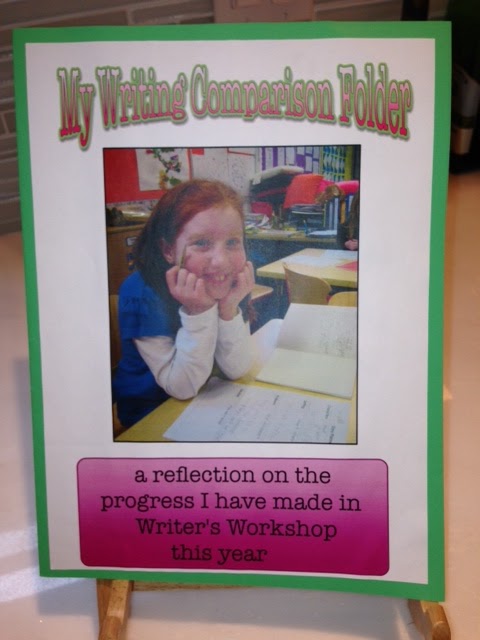
My kids have been doing these kinds of reflections since the start of their education. Here's a reflection that Bella wrote at the end of first grade. She was shown a sample of her writing from the beginning of that year, and was asked, "What do you notice about this writer? What were you like as a writer back then?" 

"I didn't have as good handwriting and now I can spell better. I thought that writing has to be really interesting and fun but now I really understand that writing can be anything. You can write about what you did in the weekend, like going to the movies or cooking with your mom."
Wow, education has come a long way. In my day, the teachers wrote the reflections, if they wrote anything at all (didn't they just write a letter grade?). We knew what kind of learners we were, depending on whether we were in the "smart" group (in math, or English, etc.), the "regular" group, or the "slow" group.

Now, it's a bit more like a corporate evaluation, where kids evaluate themselves, and teachers are able to see how those reflections correspond to or deviate from their own professional sense of each child as a student. There are benefits for the teacher: for instance, if Shira keeps saying she's terrible at math, even though the teachers know she's on target, there may be a problem with the teaching strategy or the overall message.

But even better, in my view, is that this method makes the children conscious of the purpose of their education. School is not a place where we stick kids until they're old enough to get a job; school is a place to learn things, and reflections help students become aware and take ownership of what they've learned.

Sometimes I think we'd all benefit from more reflecting. How am I doing as a mother, compared with this time last year? As a friend? As a writer? As a family chef? Am I meeting my goals, and if not, which ones have I let slip? It's easy to get on the treadmill and just keep walking, without taking the time to notice the changing scenery.


Monday, April 8, 2013

Until We Teach Them

Remember. 

Today is Yom HaShoah, Holocaust Remembrance Day. Coming so soon after Passover, the holiday that is also about remembering, I am cognizant that for parents, this day is also about teaching. We need to teach our children about the Holocaust, so that they, too, can remember. Until we teach them, they have nothing to remember.

Nothing to remember.

It's strange, isn't it? To imagine living in this world not knowing that six million of your only-two-or three-generations-removed ancestors were callously murdered? But that is what it is to be a kid. You don't know, until someone tells you. 

Bella's initiation happened not by me and not by a teacher, but in that classic educational setting: on the bus home from school. She was in second or third grade; the girl who broke the news was a year or two older. It only took a half hour for her to come home in shock, with mouthfuls of questions about concentration camps and torture, Anne Frank and Hitler. 

I don't remember when I first learned about the Holocaust, but I do remember knowing, as a child, many older people who were survivors. I remember hearing those survivors tell their stories, as guest speakers at my Jewish day school. I remember watching all nine hours of the film Shoah, in my seventh grade Judaic studies class. I remember my eight grade English teacher assigned us to choose and read an autobiography, and then make a presentation in the voice of the author. One of my classmates chose Moonwalk and came to school as Michael Jackson. I chose Alicia: My Story, and came to school as Alicia Appleman-Jurman, a heroic survivor. I identified very deeply with Alicia, and I wondered with fear: could I have survived, as a child alone, the way she had? Always, when I heard survivors' stories, I imagined my family, thrown from our home, degraded and rounded up and marked for murder. Every story was personal.

I remember--I will never forget--visiting the sites of concentration camps Auschwitz-Birkenau, Treblinka, and Majdanek as a seventeen-year-old, with USY Poland/ Israel Pilgrimage. I remember that I expected to cry, and that at first I couldn't cry, and then I cried. I remember that it was horrible and  shocking and unreal yet real, and that all those things felt just right at seventeen, when my life was already full of heightened drama. I remember that I wrote poetry about what I saw, and that some of my friends made art, and that this made us feel affirmed.

I asked Bella, today, if she remembered that conversation on the bus that took place more than a year ago. She did. I asked if she remembered why she was so shaken by it. She told me that she didn't know, then, that there was such a thing as terrorism. It was an interesting answer because for my children--whose entire lives have coincided with the wars in Iraq and Afghanistan; who are used to being patted down in the airport; who learned about 9/11 on the day that Osama Bin Laden was killed--terrorism is synonymous with evil. Bella doesn't understand, yet, about degrees of terror, or about mass murder. 

It's up to me and her dad to teach her.