Showing posts with label pregnancy. Show all posts

Friday, October 18, 2013

Milo's Story

Last week, the following remarkable Facebook status flashed across my feed:
“I just learned that 64 percent of babies with spina bifida are selectively aborted after being diagnosed. That number is heartbreaking and we need to change that. Yes Milo has spina bifida, yes Milo (and all of us) have some really really hard days. But Milo is happy, Milo is thriving and best of all Milo is doing almost everything the doctors told us he wouldn't. Yes he has to work a lot harder, but he does it all with a smile and his strength and courage is an inspiration. October is spina bifida awareness month- if you have any questions about spina bifida or Milo's story, please just ask we are always happy to share and brag about our rock star.” --Tova Berger Nicholson

Tova and I grew up in the same Jewish community on Long Island. We have not kept in close contact, so I hadn't known that her son had spina bifida. I was struck by the honesty, sincerity, and joy in her post. Since I know very little spina bifida, I took Tova up on her offer to share Milo's story. I wanted to hear about the challenges and realities of raising her son, and I wanted to help her get the word out about the condition. But mostly, I wanted to hear more of her exuberance about parenting Milo. Below are Tova's answers to my questions.


How and when did you find out that Milo has spina bifida?

When I was 16 weeks pregnant I went in for the routine quad screening blood tests. A few days later I got a call from my doctor telling me the results were concerning: a 1 in 4 chance of a neural tube defect. We got the call on a Friday afternoon and there was literally nothing we could do--it was awful. We had to wait until Monday morning to go in for a level 2 (very detailed) ultrasound. We found out that morning, via ultrasound, that my blood results were not a false positive. Our little baby did in fact have a neural tube defect, spina bifida. It was a day we will never forget.

What was your reaction? Your husband’s? Your family’s?

The flood of emotions is hard to describe. In the moment we found out I was completely heartbroken and guilty. I can remember, very vividly, the doctor who gave us the results telling me over and over again that this wasn’t my fault. But as a mother, its hard to hear your baby is ‘broken’; how could I not be to blame? Alex, my husband, is always extremely optimistic, and in that moment his world shattered. Why us? Why our baby? We knew so many other people pregnant at the same time- why was this happening to our baby? The emotions changed over the course of the pregnancy (and they are still changing). I became really angry at points. I learned from some other families who we met through spina bifida connections, that you have to go through a grieving process to arrive at acceptance of the situation. It’s a weird thought to have to grieve, but it's true. You have to grieve over the idea of a ‘perfectly healthy’ baby and come to terms with spina bifida. Alex and I went through it together--when I had a down day, he picked me up, and vice versa. We never allowed both of us to be down at the same time. We spent the first week after the diagnosis in our apartment, watching movies and crying a lot. After that week we picked ourselves up and decided we needed to do whatever we could for our little baby, and that really helped get us through. We still have our down days, but they are so rare that when we have them, we allow ourselves to have a good cry and then move on.
I think our families all put on a brave face at the time. No one wants to hear something is wrong with a family member, especially an unborn baby. But they all stood strong and gave us the support we needed. They cried with us when we needed them to, but more importantly they picked us up when we needed it most. They reminded us over and over again that this little baby was ours and we would ALL get through this together. They are still a very integral part of our support system and a major reason why Milo is doing so amazingly.

What is spina bifida? What are Milo’s symptoms?

Spina bifida is a neural tube defect. Normally, the neural tube forms early in the pregnancy and closes by the 28th day after conception, when most people don’t even know they are pregnant yet. In babies with spina bifida, a portion of the neural tube fails to develop or close properly, causing defects in the spinal cord.

There are various forms of spina bifida ranging in severity. Myelomeningocele is the most severe form, but also the most common. In this form, the baby's spinal canal remains open causing nerves to be exposed. When a baby is diagnosed with myelomeningocele, surgery is performed usually within 24 hours after birth to close the back. Hydrocephalus (an excess of cerebrospinal fluid on the brain) is unfortunately something that goes hand in hand with spina bifida; I think about 80% of children born with spina bifida will also need a shunt to control the hydrocephalus. A shunt is placed in the brain to help drain the excess fluid, usually into the stomach.
Milo was born with myelomeningocele and does require a shunt. He was born, via c-section, three weeks early because the hydrocephalus was increasing faster than the doctors liked. Milo had his back closure surgery 24 hours after birth as well as his vp shunt placed. It was really, really hard--Milo was born in the morning, and I didn’t even get to see him until that night. As soon as he was delivered they had to take him to the NICU to protect his open back and monitor him.  Alex and my parents were able to meet him, but I had to wait since I was recovering from surgery. It was the longest 12 hours. We couldn’t hold him until he was three days old. 

But, from the beginning Milo shocked everyone. He was released after only one week; two major surgeries and he bounced right back. When Milo was eight weeks old his shunt malfunctioned and we ended up back in the hospital to get it replaced, so another surgery. But again, he literally came out of surgery as Milo 2.0.  

The opening on the spine causes nerve damage; which nerves are damaged depends on where the opening is on the spine. The lower on the spine, the better for walking, but more issues arise with bowel and bladder. Milo does have a few issues in that area, but we will keep that private for his sake. Milo's ankles are pretty weak, so he uses little ankle orthotics to help him walk, although he can walk without them as well, which is amazing. The hardest thing about spina bifida is not only is it a wait-and-see game, but each case is literally so unique. We know several other people with the same level opening as Milo, and they each function so differently.

Think back to the time when you first found out that Milo had spina bifida. How does life as Milo’s mother compare to what you imagined it would be?

When you first find out your child has some sort of disorder, your mind runs crazy. When you have doctors telling you the absolute worst outcomes, it's really hard to think about life being normal. We were told our son would be a vegetable, have a low IQ, not be able to walk, wouldn’t be able to go to the bathroom, and would be in and out of hospitals and doctors' offices. We were ready to accept whatever we were handed, but, my god, life is completely different to what the doctors told us. Milo is incredibly smart--no one can get over his vocabulary and social skills--he may be behind in some physical aspects, but he more than makes up for that in cognitive development. 

Don’t get me wrong, it's not a walk in the park: no parent of a child with spina bifida will say it's easy. We have a different normal and while the first year of Milo’s life was hard and took a lot physically and mentally, it was our learning curve and we now are in our groove and we make it all work. I wish, when I was pregnant, we could have had a glimpse into our life now--we would have been able to enjoy the pregnancy so much more!

What is the most surprising thing about parenting Milo?

Milo has taught us so much. I never realized how much it's possible to learn from someone at such a young age. He has taught us to stop and slow down and really appreciate every little thing. When Milo wiggles a toe, that’s a huge deal--we celebrate that and I remember the first time I saw him do it--it's something so many people take for granted. But he has taught us to never take for granted even the smallest thing. Alex and I had a pretty strong relationship before we got pregnant with Milo, but through pregnancy and these last 2+ years he has made us such a strong force; very little can get in our way.

What is the hardest thing?

It has gotten easier, but it's hard to see what other children Milo’s age, and younger, are able to do, and without any thought. In the playground they are running, jumping, going up and down the steps alone. When we go to the playground, Milo can do it all, he just needs his mama or daddy right there to help him. It doesn’t bother him, which makes it a bit easier for us, but it does still break my heart a bit. Milo knows a different normal than we do and it's hard to remember that. We do try to make sure he doesn’t feel different--we want to make sure he knows he is like everyone else. Instead of needing glasses to see or hearing aids to help hear, Milo needs braces to help walk, and that’s ok. And we want to make sure he always knows that.

What is the best thing?

The best thing is seeing how happy Milo is. Milo has worked so hard to get to where he is today--he started walking at 25 months and he hasn’t looked back. He is so proud of himself with every thing he has achieved with his own hard work. There is nothing more heart-warming than seeing your child achieve something they have been working so long and hard on, but then seeing how proud he is of himself is just the best. Milo has the most amazing attitude and literally just goes with the flow and it really has helped him overcome so much. His happiness is everything to us and when we do have that rare down day, seeing him happy really helps put things into perspective.

What else would you like people to know about your child, your family, or this condition?

Milo is a normal 28 month old. He is doing everything a two-year-old is supposed to do: he goes to a two’s program, he loves to color, play with trucks, and yes, he has his tantrums. Milo has spina bifida; he always will. But it's just a part of who he is, it is not WHO he is. We are always happy to talk about it, but we don’t make it the first thing people know, as we don’t want him treated differently from anyone else. People have said, how great he looks and you would never know anything was wrong. And I know they mean well, and who knows, I might have said something similar to other families as well, before we were in our situation. But the truth is, there is nothing wrong with Milo. People hear a diagnosis and they shudder and apologize. There is nothing to apologize for. If you have met and know Milo, you know that he is more than OK. I keep going back to it, but his happiness is everything. Yes, we will have bumps down the road, but his attitude will help overcome those bumps.
Milo is a normal 28 month old. He is doing everything a two-year-old is supposed to do: he goes to a two’s program, he loves to color, play with trucks, and yes, he has his tantrums. Milo has spina bifida; he always will. But it's just a part of who he is, it is not WHO he is.
One other thing: if you are ever in the unfortunate situation of receiving a diagnosis for your child, no matter what it is, do your research. Doctors are the experts on some things, but not everything. Find families who are dealing with it every day and talk to them; they will know best and tell it like it is. If we had listened to what the doctors told us, who knows where we would be today, and the thought honestly makes me sick. There are always families out there that would love to share their stories and help others.

What resources (websites, organizations) have helped you the most?

While I was pregnant I found a spina bifida kids group on babycenter. Those families saved us during our pregnancy. Hearing their stories and seeing their children really helped keep our spirits up. In the last year I joined a few groups on Facebook, and it's really amazing what a tight-knit community it is. It's really refreshing to be part of community where everyone "gets it". It's a place where people come to share and brag when their child gets up on all fours, or sits unassisted, or takes their first step, and everyone is excited, as we all know that feeling.

What do you do professionally?

I am a stay-at-home mom. It’s so cliche, but so true: being a stay at home mom is the hardest job I have ever had, but by far the most rewarding.




Monday, August 5, 2013

The Girl We Lost


There was a time, not too long ago, when I wouldn't have been able to read an opinion piece called End of Life, At Birth. The title alone would have kept me away. Too liable to scratch away at the scab that has finally begun to harden over my wound.

Written by Dr. April Dworetz, a neonatologist, the piece examines the moral quandary of sustaining life in very premature infants.

Earlier this year, I shared my children's birth stories, on their birthdays. But last month, I let my third child's birthday come and go. She was born July 8, 2009, though she never took a breath.

When my water broke at 22 weeks, 4 days, I knew it was very bad. I knew that where we were living, in the UK, newborns would not get any medical care before 24 weeks gestation. But I also knew that even if we crossed that shaky line, it wouldn't guarantee anything in terms of her health. Unlike the parents of 23-week baby "Miracle", described in Dworetz's piece, Josh and I are scientifically-minded and well-informed; we knew the many risks associated with extreme premature birth.

I knew that babies need amniotic fluid to grow, and that mine was going, fast, along with worrying bloody show. I knew that there was no way to stop the leak, nor to put substitute fluid back inside. But there was so much I didn't know. No one at the public hospital where I was admitted ever looked me in the eye and told me that I was going to lose my baby. I understand, completely, why Miracle's parents allowed their child to be resuscitated. The opposite choice is so shocking, it hardly registers.

Our baby was going to die? But we had just picked up a hand-me-down crib from a friend. Our daughters, ages 6 and 4, had attended the 20 week ultrasound, and were thrilled to learn they would have another sister.

I would have to birth the baby. For some reason, I thought the doctors could spare me from this; rescue me from the baby dying inside me. But day followed day, as my body depleted itself of amniotic fluid, but refrained from going into active labor. I've since learned that it can be hard for a woman's body to go into labor before the hormones are right and ripe. If I had been more comfortable with death, and if anyone had given me frank choices, I might have gone home and waited, however many days or weeks it might have taken, until my body was ready to give birth. But I was not comfortable with death, and no one said a thing.

Also, there was that unspeakable fear hanging over my thoughts: if she, by some unlikely "miracle" made it past 24 weeks, they might put her on machines; keep her alive. And, as Dr. Dworetz explores in detail, there were many reasons to question that course of action, for the affliction she might have experienced, and for our own.

I forbade my daughters from coming to see me; I didn't even speak to them on the phone. It was like a state of purgatory, in which I couldn't explain what was happening, so I chose not to try. After one ultrasound, in which I held my gaze away from the screen, terrified of seeing both the technician's face, and my baby's, I wanted it to be over. I knew that our baby did not have a future, and I felt like I was in hell. I couldn't continue to live until this was over.

I asked for, and was given, drugs to bring on active labor. I had to sign a piece of paper, as technically I was choosing to end the pregnancy. (If I had been in Texas, following the passage of recent laws, my desperate pleas to bring this suffering to an end would have been ignored.)

A neonatologist, the most compassionate and straight-talking caregiver I encountered in my five-day ordeal, told me what to expect. She said that it was possible that the baby would be alive when she was born, but that because her lungs were not fully developed, she would not live more than a few hours. She told me that either way, I could hold the baby.

I gave birth the regular way. Though she only weighed 1 lb. 8 oz., the birth was more painful than any of my three full-term births. There's a difference between pain and suffering, I learned recently in a childbirth educator course. All my births were painful, but with the others the pain was tempered by intention and joy and excitement. This birth was replete with suffering.

A nurse wrapped her in a blanket so only her ashen face was showing. She felt so light in my arms, like a tiny bundle of feathers. The nurse said, "she has your hair."

Though there was no religious obligation to have a funeral or sit shiva, our supportive rabbi helped to arrange a burial in a Jewish cemetery. Though there were family members who discouraged it, I insisted on attending. The day after I was discharged from the hospital, we drove to north London and watched as Leah Naomi was buried in an unmarked grave, full of babies, secrets, and loss.

I noticed that most people in my life didn't want to talk about the baby that had failed to live. Some people never ever mentioned it to me. It was like I had never been pregnant. For whatever reason, it was hard to talk about.

It's hard to write about, too. There was so much guilt, so much second-guessing, as I wondered what I must have done wrong; I felt like I had failed grandiosely as a mother. But that caring neonatologist in the hospital said one other comforting thing I'll never forget: she said that considering the innumerable things that can go awry in the process of growing a baby, the miracle is that they ever come out of the process well and fully-formed.

Dr. Dworetz's piece starts with Jackie Kennedy's loss, which I have thought about a lot: how publicly she was pregnant, and how publicly she was forced to mourn. Pregnancy, for most women, is a time of celebration and joy. What I didn't know, until after, is that loss is an ever-present part of the fragile life-giving process. I had entered the secret society in which women--some friends who had never before mentioned a word--shared stories of their own or their relatives' losses. I attended a support group, where I found out that babies die; not just mine.

As explored in another New York Times piece from this past weekend, trauma is an ever-present part of everyone's life, and our traumas are bound to us. They do not simply evaporate. This one will be with me, always.

Friday, March 15, 2013

What I've Learned From Lena Dunham

Have you noticed the photo at the top of this blog? The belly shot. That belly is huge, right? It's headless. It could be anyone. But it's not: it's me.

I've been watching the second season of Girls, and I often think of Lena Dunham when I catch a glimpse of that photo. I think about the scene where she plays ping pong in nothing but her undies. How calm she looks. She's of a younger generation than me -- the generation that lets everything hang out on Facebook, and that doesn't seem to put much value in privacy. But, even so, her bravery is palpable. She is not a simple exhibitionist. She's a bit of a radical. She's daring the world to judge her: her body, her comfort with that body, and her commitment to realism. 

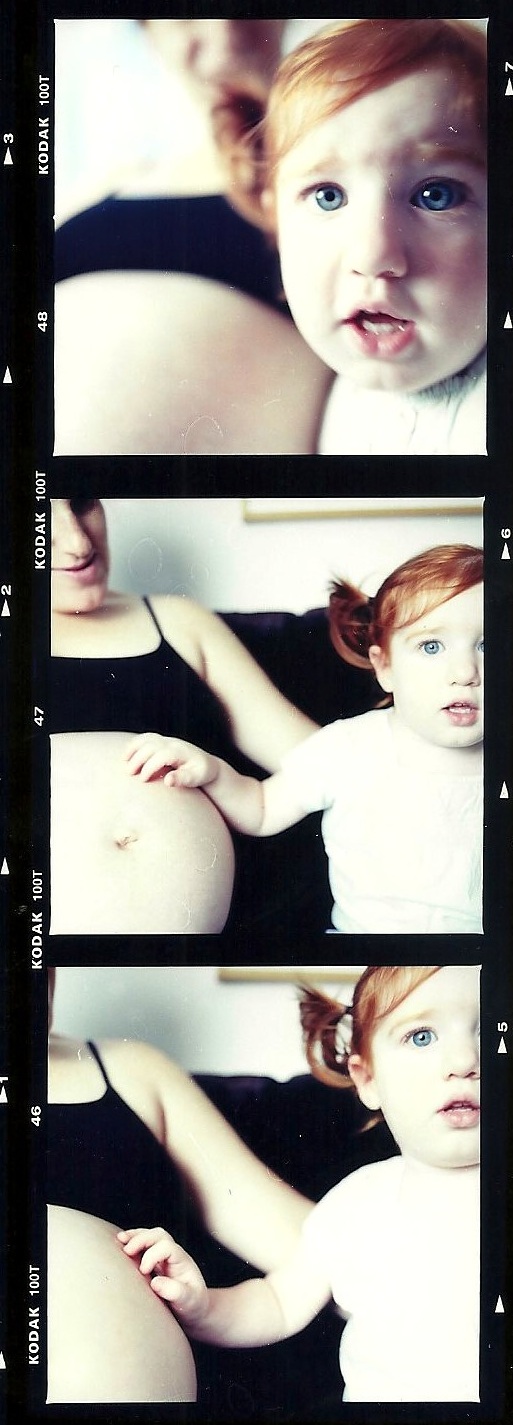
My belly shot was taken at the end of my pregnancy with Ruby by Julia Smith, a talented photographer and a good friend. She offered to do a shoot of me with Bella, who was 18 or 19 months at the time. Julia usually points her camera at my kids, not at me. Her photos are displayed in frames all around my home. But the pictures from that particular photo shoot never made it beyond contact sheets, which to this day are sitting in a box.

I wasn't comfortable with how I looked in them. Being pregnant didn't make me feel beautiful. It made me feel huge (and as you can see, I was). I've never been an exhibitionist, and I've never been one to enjoy my own image in photos. (At our wedding, we didn't have a videographer: I've never liked seeing myself on film, either.) Also, I would never normally let myself be photographed without a shirt on. The result, Julia's talents notwithstanding, was something I wanted to keep in a box.

And yet, that belly photo graces the top of my blog. I've been feeling more sensitive about that as my blog has attracted attention this past week from people well beyond the confines of the pregnancy-and-birth community. (And lots of rabbis!)

I chose the picture because I couldn't think of a more apt image to illustrate the reality of becoming a parent: the physical enormity of growing a baby, of waiting forty weeks (or, like me, 41) to meet the person whom you made. But instead of choosing a picture of a baby, I chose a picture of me, the mother. Because this blog is really about her. It is personal, and it's real. It's about the way life is, not the way I might want it to be. It takes bravery to write that way, and I am trying to be brave.

Thank you, Julia, for capturing a moment in time that I can never get back.

And thank you, Lena, for getting me to take the photos out of the box.


Wednesday, February 27, 2013

Move Over, Birth Trauma. It's Time for Joy

This post is for a friend who is in the final days of pregnancy with her third child. She is tired, 'over it', and ready to meet the kid already, both emotionally and literally, as she is nesting up a storm. She's trying to be patient (compared to how I was at this stage--ready to stand on my head if it would get that baby out). She's worrying about names, about childcare, about having space and time for all of her kids. All of that is to be expected. 

What concerns me is that she's scared about the birth.

Unlike first-time moms, she's not frightened of the unknown. She not worried about her friend's horrible labors, or a birth she saw on TV, or a co-worker's fright-filled tales. She's scared because of her own first two births. She's scared because she doesn't want another broken tailbone and dozens of stitches like she had with her first baby. She's scared because she doesn't want an emergency Caesarian birth with prolonged pain and difficulty breastfeeding, like she had with her second baby.

Birth is many things: emotionally wrenching, painful, joyful, ecstatic. But it shouldn't have to be traumatic. I could sing this from the rooftops. There's too much birth trauma out there, and too much denying of women's emotional and physical pain from their births, as women are told they should be happy they have a baby. Period. Women are constantly told that the experience of birth doesn't or shouldn't matter. 

But the experience does matter. Growing and delivering a baby is an overwhelming, life-altering experience, second only, perhaps, to raising one. 

Here's my message to my friend:
You are a beautiful, wonderful, capable mother to two terrific kids. You will soon be all that and more to your third. You have the power to birth your baby. I believe in you. You are strong, and you are brave. Surround yourself, in these final days of growing your wonder baby, with people who will remind you of all of these things. When you are in labor, remember that you only need to get through one contraction. When that one is over, you'll have a break. Just focus on one at a time. When it's time to deliver, stand or squat or lean. Protect yourself and your tailbone by getting into a good position for that baby to emerge, no matter the size. I pray that you will both be healthy, and safe and happy. I pray that this will be the birth you've been waiting for. 
And as I said to you, on learning that you were expecting this child: the first is a biological necessity, the second is fulfillment of a plan, and the third is pure joy.


Thursday, January 31, 2013

Welcome Sunshine, Part Two

Part One recap: 41 weeks pregnant, in hospital. Finally, labor starts picking up. While the details are hazy for me, my lovely doula Jill Fransen wrote an account. Thank you, Jill, both for writing the story and for agreeing to let me share parts of it, here.
When I arrived around 4:00, your dad was there, and your mom arrived in a little while with food for Josh. Your contractions were tolerable as you sat in the rocker. That rocker would be your friend for many hours that night. 
After your folks left we got down to the real business of labor. Your contractions were really quite close and strong. It seems that your labor was a series of rhythms. The rocker was very effective...you would "OM" through the contraction...going inward and being very focused. Then we decided to walk, stopping every few feet as you bent over holding onto the rail. You were determined to just continue to let your body and baby work together. You got in the shower; we listened to Sting, Stevie and some jazz. 
You labored--your contractions were mounting. You were getting very tired...your energy was being drained, and still your dilation was very slow. Things were getting intolerable: from the birth ball, to the shower, back to the chair, slow dancing with Josh, back rubs, foot rubs, hand massages...it all helped, but you were about to hit a wall. What you needed most was rest. Around 10:30 the nurse removed the rest of the Cervidil to give you a break from the piggybacking contractions. Finally around 1:30 in the morning, you got in bed, had a half dose of Demerol, and were able to get some rest. 
Here's what I remember about this part: I remember that the nurse saw me working hard and said something to the effect of, "I don't think you can go on like this much longer." She wanted me to have pain relief, but an epidural was not an option because I wasn't dilated enough (not that I wanted one anyway). I consented to the Demerol because I believed that I was still at the beginning of labor--that it could potentially be another day or two before the baby would be born, and I just didn't see how I could go on for that long. Josh was also exhausted because we'd been up for past several nights with false-alarms.

Josh opened up the couch, I positioned myself by your side, your small hand in mine. We turned off the lights and you got the rest you needed. I have rarely seem Demerol work so perfectly. You were aware of the contraction, only at the peak...you moved around, moaned, then were able to fall back into a restful peace. I did not leave your side as I held your hand and talked you through the peak of each contraction.
What I remember is that the contractions at this point were incredibly strong and hard, and that I couldn't "OM" anymore because I was loopy from the drugs. So I was literally moaning in pain at the peak of the contractions. While the narcotic undoubtedly allowed me to rest in bed (I couldn't have laid down otherwise), it actually took away my ability to concentrate and deal with the pain. I was very, very grateful to have Jill's hand to squeeze during that time.
Then, an amazing thing happened. As you roused during a big contraction, you said something popped--"my water broke." While you weren't particularly happy at that point, it sure put a smile on my face. Within a half hour the nurse checked you and you were 6 cm dilated! Josh woke up; the lights went back up a little...we were on baby alert. You went to the bathroom and sat there for a while. I believe that is where transition took place, because you experienced powerful urges to push. By the time you returned to bed, at about 2:30am,  you were 9 cm. dilated. This now was exactly the opposite of the old axiom: Hurry up and wait! This was, rather: Wait and hurry up! Dr. S. had to be called--you were going to have a baby! 
Now you were experiencing real bearing down urges...almost uncontrollable urges. This was when Josh just shone. He had you concentrate on his face, on his finger, guiding you through those extreme urges to push as we waited for the doctor to arrive.
To explain: the nurse was in a bit of a panic, as the doctor was not there. She told Josh to hold his finger in front of my face and instructed me to blow out the candle...instead of pushing. So, essentially I was holding the baby in due to absence of the doctor. Good times!
You were just amazing as you blew on the birthday candle that was Josh's finger. The urge at that time is greater than any other bodily function; watching you two at that moment I knew you were quite a team. I think the nurse thought she would have to deliver this little bundle...the first time we looked we could see about one eighth of her little head peeking out. So we were very grateful when Dr. S. walked in, sleepy and so beautifully pregnant herself.
Because you had done so much work before; because you had done so much breathing down and letting your baby just descend, you only had to push two or three times, and there she was...in all her glory of girl and red hair.
When Bella was placed on my chest I cried, and Josh cried, and I kept saying, "Beautiful! Beautiful!" because she was.


Isabel Renee
January 30, 2003
3:45 AM
8 pounds, 9 ounces

Wednesday, January 30, 2013

Bella's Birth Story, Part One


In honor of Bella's birthday: her birth story. It only took me ten years...

About a week before my due date I moved back into my parents' house, where I slept in my childhood bedroom. This was because my Ob-Gyn, Dr. S., was my father's partner, and also the same doctor I'd been seeing since I was eighteen. No one wanted me to have to travel to Long Island from the city whilst in labor. It wasn't half bad having my parents watching over me and feeding me, like I was a child again. But there wasn't much to do other than wait, and being away from home really put a big black exclamation mark over that magical and elusive due date.

When that date came, January 22nd, 2003, I started work on my labor project, an idea I took from the inspirational book, Birthing From Within. I made a birthday cake for my little Sunshine, the name we called her throughout my pregnancy, not knowing that she was a she. If only I had actually been in labor... (We stuck the cake in the freezer and brought it to the hospital after Bella was born, where we shared it with the nursing staff. No awards for me in the cake-decorating dept., I know.)


A few days later, I started having daily non-stress tests (a half hour or so strapped to the fetal monitor) at the doctor's office. At each test, Dr. S. said, "The baby sounds great. We can induce you now, you know." 

Josh and I took a lot of walks, as I was determined to move the baby down and get labor going. It was freezing out, one of those bitter winter weeks, so we found a place to walk inside: up and down every aisle of Target and Best Buy and Home Depot. I thought maybe Sunshine was staying put because it was simply too cold out for babies (or because she was afraid of big box stores).

On day five or six, the doctor's message changed slightly: "Soon it will be time to get that baby out." She stripped my membranes (ow!) and said, "You're really not dilated at all. Maybe a one." What I heard was: Nothing's happening. Your body is not doing what it needs to. That baby is never coming out without our help. 

On day seven, at the prospect of Josh having to leave to go back to work in the city, I gave up. I didn't want to be induced. I knew that inductions with first babies have a higher rate of resulting in Caesarean births. But I was beyond ready to be done with the waiting and to meet my baby. 

When I arrived in the hospital (straight from the doctor's office) for my induction on January 29th, I was already having patterned contractions, which had been happening on and off for days. I hadn't slept well the past two nights, and I was already tired. The doctor inserted a Cervidil suppository, and I had to stay in bed with a large uncomfortable plastic belt around my middle. (Whoosh, whoosh, thump, thump..the sound of that monitor never ending; Josh staring at the printouts because there was little else to do.) "In the morning, we'll start you on pitocin," Dr. S. said. Then, pregnant herself, she went home to sleep.

When the contractions soon became strong, I was very thankful to have my wonderful doula, Jill Fransen, at my side. She encouraged me to ask for permission to walk around, and reminded me to practice techniques to get through each contraction. I had prepared for this. I believed then, as I do now, in the mind-body connection that allows a woman to give birth. I tried to gain strength from my (hokey) piece of birth art (another Birthing From Within inspiration), and reminded myself what I had to do.


I don't have a good sense of the timing or details of what happened next, but lucky for me, Jill wrote a detailed description of the birth. 

Tomorrow: Part Two, Jill's account of Bella's birth.